
The Noisy Public Landscape and Ges’s Communication Strategy
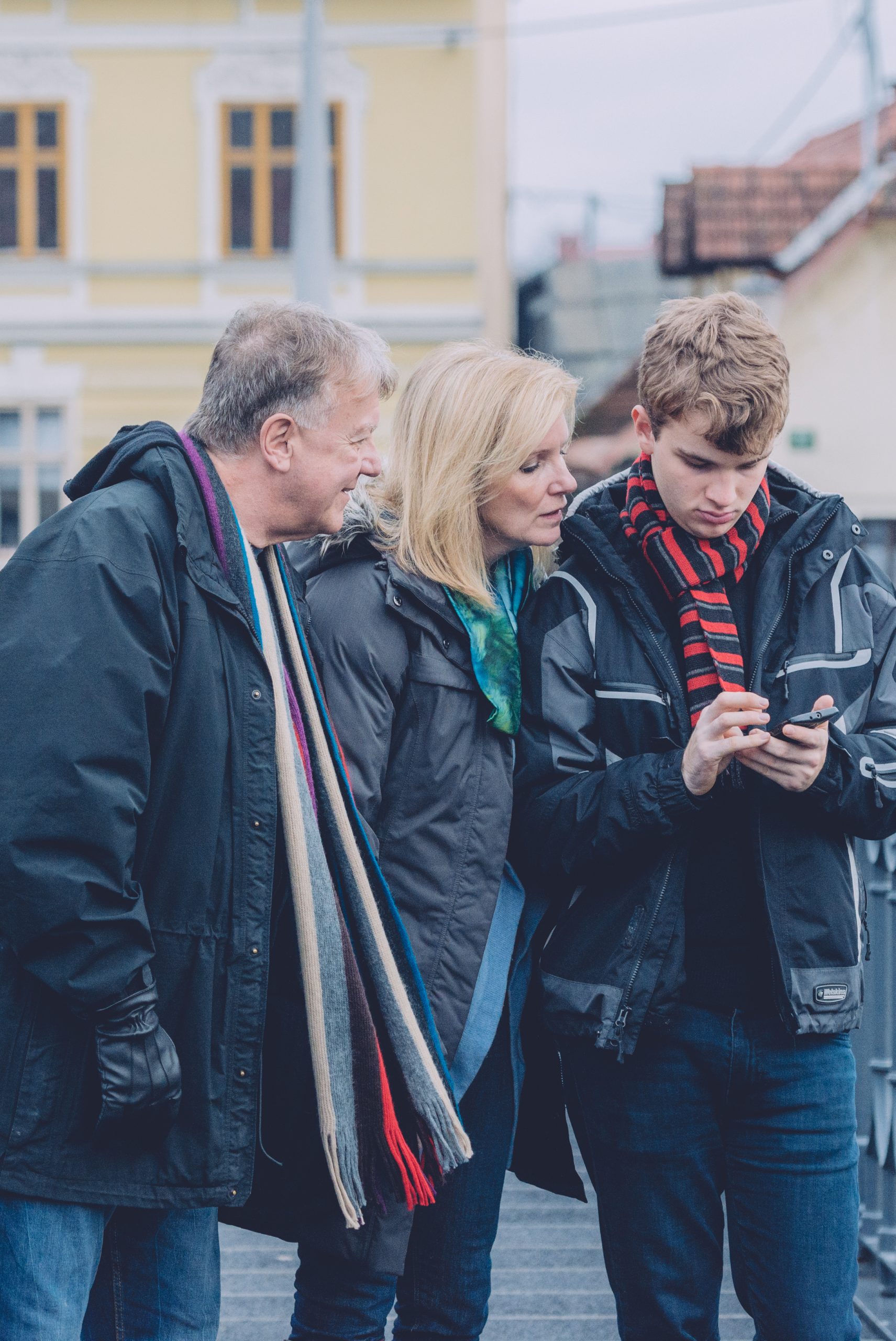
Understanding the social model of disability and mattering in public spaces helps us see how ordinary interactions can become disabling. When Ges (“Jess”) navigates public spaces like building lobbies, grocery stores, or recreation centres, his vocalizations compete with the clatter of business and hurried conversations. He considers himself a speaker, even though all his words are unintelligible to strangers. His garbled speech often causes listeners to ask, “What did you say?”
In those moments, Ges presses a small button on his smartphone, and a brief, synthesized phrase from his voice output software speaks for him. The assistive technology cue isn’t a fallback for silence; it’s a supplement activated only when others miss his spoken words. His way of communicating is different. His phone’s voice output software doesn’t replace his speech but helps when others (including me!) don’t understand him.
Ironically, using this technology can make his voice seem inadequate, harming his sense of mattering. Though clear, his synthetic words often face impatience, as if the problem isn’t in the medium but in him.
Mattering = Noticeability + Valuation
Gordon Flett describes mattering as the intersection of noticeability (being seen or heard) and valuation (being regarded as worthy of attention). Ges’s loud efforts guarantee the first pillar when people inevitably notice him. What happens next determines whether the interaction affirms or negates his sense of mattering. If he receives an impatient reaction, perhaps a quick sigh, eye roll, or a brusque “What?”, this tells him that his voice has been heard, but isn’t valued. Even the brief, artificial prompt meant to close the gap can be met with the same impatience, reinforcing the idea that his presence doesn’t matter.
Impatience Reveals Societal Assumptions About Speech
The listener’s impatience reveals an underlying assumption: communication must conform to a socially accepted standard of clarity and speed. Anything else is treated as a nuisance, a disruption, to the flow of the day. What Ges does is unexpected. Ges’s experience offers a vivid illustration of the social model of disability, showing how “disability” is not solely a function of an individual’s impairments but is actively produced by the attitudes and reactions of others. My son’s impairments mean he speaks differently, but he doesn’t become disabled until environments drown him out, and others disregard his manner of communicating.
The Social Model of Disability in Ges’s Experience
Ges’s story shows how strangers in public spaces can supply the first pillar of noticeability, while simultaneously denying the second of being valued, thereby turning his communicative difference into a disabling barrier.
From the perspective of the social model, disability emerges when societal structures and attitudes fail to accommodate human diversity. Ges’s garbled speech is an impairment, but it becomes disabling because the environment of noisy public spaces, time-pressed strangers, and normative expectations of speech offers no accommodation. The lack of valuation transforms a manageable communication difference into a barrier that limits his participation, heightens anxiety, and fuels withdrawal.
What Can We Do? Applying the Social Model of Disability and Mattering in Public Spaces
Four young students huddle over an iPad on the schoolyard, absorbed in what’s being said, providing a glimpse of how technology can create inclusive, mattering moments in public spaces.
To shift the narrative from “disability created by the individual” to “disability constructed by society,” we must address both pillars of mattering:
Enhancing Valuation
- Active Listening Training – Simple workplace or community workshops can teach people to pause, give space, and respond respectfully, even when comprehension is delayed.
- Normalization of Assistive Tech – Treating synthesized speech as a legitimate part of conversation, rather than a novelty, signals that the speaker’s contribution is valued regardless of the delivery method.
Reducing Disability
- Acoustic Adjustments – Reducing background noise in lobbies and stores (e.g., softer flooring, strategic placement of speakers) creates a calmer auditory landscape where diverse speech patterns are easier to process.
- Visual Cues – Providing optional visual displays of spoken text can bridge gaps without forcing the speaker to rely solely on auditory channels. Ges frequently does this by turning his phone to the listener so they can read what was said.
Moving Beyond Noticeability to Mattering and True Inclusion
When the rest of us adopt these practices, we move beyond mere noticeability and begin to affirm Ges’s presence. The result is a public sphere where his voice, whether garbled, synthesized, or both, is recognized as a meaningful contribution rather than something weird and unexpected.

How much more difficult it must be for him in our society, where convenience has become part of life. We don’t go to Blockbuster to search for a movie to watch, stand in line to rent it, and take it home – we open Netflix and push a button. Ges is part of a generation that expects to get what it wants almost instantly – or at least have it brought to them the next day. I can see why anyone who needs a little more time to communicate would have a hard time getting people to listen.
Indeed. We live in a 10 second sound bit world. Thank you for reading.
This is an illuminating and humane explanation of what Jess and so many other people with particular strengths and limitations go through. In this altogether so fast-paced world, Jess and others end up not mattering. This article helps to slow me down and connect; everyone needs to matter.
Thank you for reading and taking the time to comment. Indeed. We ALL need to feel like we matter.
This is very interesting and instructive. It is a great reminder to all us that people have different ways of being in the world and that our responses to them matter. Most of us have had experience of feeling invalidated or demeaned by someone’s reaction to us. That can only be more pronounced for those with different ways of communicating. Thank you for expanding our understanding.
I’m happy to hear if it was instructive! Thank you for reading and taking the time to send your thoughts.
LOve your insight – -i have to keep reminding myself –Never judge a book by the cover
YES! the perception of disability only exists with Societal perceptions of what is the norm??
The sense of “norm” depends on how your life is working……..
Thanks for taking the time to read and comment Brian.
It takes my breath away seeing how well you describe Ges’s experiences for us to learn and be more positively responsive. What a treasured contribution to this increasingly isolated world. There’s some intentional energy that brought the two of you together. We are better off for it. Thank you.
Bev, what generous comments you have shared! Thank you kindly.